Sunday, September 27, 2009

Just beachy

I've used beach glass several times before I took Barbara Becker Simon's class.

My first beach glass piece was done early on and incorporated a piece of beach "ceramic" that my husband found. I followed Tim McCreight's directions in one of his early books and carved a plaster piece to match the size and shape of the glass. (That was not fun!) Then I made the backing and a bezel out of the lump clay. Since the directions did not specify how thick to make the bezel I think I over did it. After firing the plaster stand-in inside the bezel, chopping the wet plaster out (that was not fun either) and trying for hours to get the too thick bezel bent over the piece, it was done. It wasn't as level as I thought it should be (I do think this was mentioned in an earlier post) and I just couldn't leave well enough alone. After two taps with the hammer the third was the charm; the piece broke. It's not really that visible and it just makes it look like an antique.

The second attempt at working with beach glass came after reading a book by Louise Duhammel (again not sure this is right as I'm not at home to check.) She rolled coils of clay and wrapped them around a piece of beach glass. So, I tried her method. The beach glass was a beautiful turquoise color when it went in the kiln and was an olive green when it came out. It was not a bad color, but I really liked the turquoise.


My last attempt was following the presentation by Simon on how to combine metal clay and glass. This time I took a very ordinary piece of frosted white beach glass (yes I know, all beach glass is frosted) just to see what would happen. I loved the results. Barbara said the silver can affect the color of the glass. It can turn it amber. (So I guess turquoise and amber make olive.)
The white glass turned totally amber and also cleared up. I fired at 1470 degrees for 45 minutes and took an hour to ramp up to that temperature. And as with other glass, when the firing was done, I opened the kiln door until the temperature got below 1000 degrees and then shut the door. (Had to do this about five times to get the temperature to stay below 1000.) Once the temperature got below 300 I was able to open the door, finish cooling the pieces so I could see what happened. We also learned that glass and metal clay will fuse together at 1470, so I did not need to incorporate any kind of mechanical hold to hold the glass in place. This piece was also fired on a thin sheet of paper made for firing glass. Didn't use it on the turquoise piece. I really liked the way this piece turned out. It doesn't have a patina on it yet, but I do think a patina would look good on it. (Will show it again when it does.)


For common types of beach glass, this is a viable method of design. If I had a unique piece of beach glass that I did not want to change the color, there are other methods of design that would be better. I've got a few of those pieces and when I try the other methods I'll be sure to share.


Thursday, September 24, 2009

A Copper Christmas


The copper pieces are done!! The above photo shows fired and polished pieces next to the unfired pieces.

It was a surprise when I took the lid off the stainless steel container they were fired in. I expected dark gray pieces of metal, but was greeted by a very orange color. After the first firing the pieces were a dark gray but that is probably because they were exposed to oxygen during that firing process which doesn't happen when they are buried in charcoal.


It is a messy firing though. The kiln has to be vacuumed out from all the black dust.


The construction joints were fine and they were what I was worried about. The tiny charm had a loop attached to the top and the oval earrings had a circle cut apart, put into the hole in the oval and the seam was pasted back together.

There were a couple of cracks though on the back of the disk earrings where the stones were. The cracks weren't anything major and I'm not going to do anything about them. The worst thing that happened had nothing to do with the copper clay. (I forgot to clean the stones and now my pretty pink czs are rather hazy.) They look okay since it is an even haze but I really liked the pink with the copper. (Oh, and peridot looks pretty with a haze too! That's why I have a last minute checklist posted on my wall. Obviously I don't look at it. Maybe I should move it over by the kiln. Uh, I have one on the wall by the kiln. What is it going to take? Usually once is enough but not in this case.)


Sorry, but my photos aren't the best. I didn't have time to take better ones but at least you get the idea. The finished pieces do have a patina added. The shiny copper was really pretty but the patina just added the right contrast for the textures to show.

Wednesday, September 23, 2009

It's Christmas tomorrow

Finally got around to firing my finished copper pieces. I only had three of them done but decided that I might as well get them fired. If I waited until they were all done it could be next year.

Copper clay is fired in coconut charcoal (no, it's not acorn charcoal!) The charcoal has to be fired for three and a half hours before using it. Not sure why, that's just what I was told.

I've heard all different methods of firing the copper clay, but went with the method that Jan Durkin (from my metal clay guild) used. I fired the pieces flat on a shelf for one hour at 500 degrees F. As soon as they were cool enough to handle, I put them in the stainless steel container on top of one inch of the charcoal. All the pieces were laid around the center. Then I poured the rest of the charcoal on top, (used a one pound bag) and ramped the kiln at full speed to 1650 degrees. I fired them for three hours and forty-five minutes. (The directions were for one hour and thirty minutes but I just thought I'd be different.)

I did learn that my kiln won't get to 500 degrees and hold for one hour if I use full speed. I had to use speed number two (500 degrees per hour) for it to work. Using full speed kept shutting my kiln off as soon as it reached temp. (Hopefully this isn't an omen of more problems with my controller. The book never has my problem listed.)

Now begins the wait. The kiln is supposed to cool down on its own, so I just left the studio without peeking. Hopefully all works out well. We'll see tomorrow. The anticipation is just like Christmas. I'll share (hopefully good news) tomorrow night.

Sunday, September 20, 2009

Coconuts... the difference between age and youth


This blog is not about coconuts..... it's about acorns. (My four year old grandson calls them coconuts.)

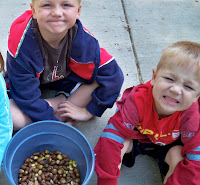
The grandsons stayed overnight yesterday. This morning they wanted me to come to the playground and see their stash of acorns under the play set. They were so excited about those acorns. They wanted to collect more, so I gave them a bucket and tried to talk them into cleaning off my deck. There are thousands of acorns on the back deck. (Actually, hundreds of thousands of them.!) The little girl up the street got into the excitement of it all and the three of them were out back squealing with delight at every acorn they found. (I was wondering what the neighbors were thinking.) The porch acorns didn't excite them enough though (darn!) So, they went in search of acorns in their natural state...... under the tree.

To me the acorns are nothing more than a big mess that has to be swept off the deck. I can hear them bouncing, banging and pinging as they hit my deck, table and chairs. When we are trying to sleep, it sounds like WW II out there. That big oak tree by the deck literally throws them. (The little neighbor girl started to throw them back.) We take our life in our hands when we venture onto the deck. Haven't been hit by one yet, but I don't imagine it would feel very good. There is nothing to get excited about when it comes to acorns.

I remember when acorns did excite me. One of my first pieces of jewelry when I was a kid was a bracelet I made by stringing acorns and pearls. I used a long needle and threaded a string through the acorn like it was a bead, alternating it with pearls. (Don't know how I did that. Don't think I would have the strength now to push it through an acorn.) I would wear that bracelet for a long time until it fell apart. I loved that bracelet. Sometimes I think I should make silver acorns and make that bracelet again with the pearls. Not sure though that the contrast of brown and white, raw nature and shiny pearly nature could be captured in silver.
I'll have to give that one some thought.


The grandsons wanted to know if they could go around the neighborhood. The three of them wanted to try to sell their precious acorns. Maybe I'm a millionaire and don't know it!

Wednesday, September 16, 2009

Matching sets?


Personally I don't wear matching sets of jewelry. Just a quirk of mine I guess, but I feel like it's just too much. Well, I sort of wear matching sets. I'll wear a bracelet that matches my earrings, but not a necklace. Not sure why that is.

Actually I kind of like things that are similar, but not matching. I once had a pair of earrings that didn't match (on purpose.) I was told though not to try to sell those kind of earrings (at least not in Florida.)

My brother in law once asked me if I made pieces to match. So, I made a necklace, earrings and bracelet out of a beautiful blue stone (got a mental block about learning my stones) that had a nice weight to it and just felt good in the hand. There was no metal clay involved, just stringing the pieces and adding some sterling silver beads. The set sold all right..... to three different people. Haven't made a three piece set since.

Anyway, the gist of this post is to take a poll to find out if people like sets. Please take a minute and share your opinion.

Tuesday, September 15, 2009

Texture party


There are a lot of really nice texture plates available to use with polymer and metal clay. I know I have my favorites and so do my students. Using the same plates over and over again though gets boring.

When I went to Arrowmont in April, we were supposed to have a texture swap. For some reason, I thought we were supposed to make our textures. (Many brought ready made or natural textures to share.) Since I procrastinated (NO!) and didn't have mine made ahead of time, I quickly grabbed some objects and a big block of white polymer clay as I headed out the door. So, in the hotel room on the way down, I was trying to figure out what I was going to do. My friend Laurie, graciously donated the bottom of her shoe which had a very interesting pattern on it. One of the objects I brought was a very heavy, very large chain (and I use to wear that around my neck?) I started pushing it into the flattened polymer clay in a repetitious pattern. That was fun! Next I grabbed a paper clip and started playing with it. Got two texture plates from that one. The last texture was made with a fine toothed comb. I could have gone on and on because it was so much fun. (Guess it doesn't take much to amuse me.)

Since the polymer had to be baked, I carefully stacked and packed my textures until I got to the condo and was able to bake them. Making the textures is one thing but being able to imagine what they are going to look like is another. (This can be solved by using polymer clay to test them out.)

Arrowmont was in Aril. I never got around to trying out my textures until this past August. Even then I've only tried out three of them but I really like the way they turned out.

The one texture and the enameling I did in some of the spaces remind me of something I did in Junior High. (How long ago was that?) The weird thing is that I still have it. (Can you say pack rat?)

Anyway, making your own textures is fun and the cure for texture boredom. How about a texture party?

Friday, September 11, 2009

Save the silverware


Antique silverware makes beautiful jewelry. Mina Cavanaugh from Arizona makes antique silverware jewelry and her pieces are gorgeous. They are so shiny and striking. Mina says many of the silverware pieces are black when she gets them but she loves the buffing and the polishing process. (Not me!!) I had the pleasure of teaching Mina about metal clay so that she can add another dimension to her jewelry making.

Mina brought some of her pieces with her to class and allowed me to make molds of some of the silverware pieces. (She had some very nice patterns on her pieces.) I made about three or four molds of some of my favorite patterns. I also discovered a silverware bracelet in one of my books by Irina Meich (I think that is the spelling. I'm writing this at 3:00 in the morning and my book is in the bedroom where my husband is sound asleep...... lucky him!) So, voila I didn't even have to figure out how to make one of the bracelets. The directions were right there. (Don't you love it when the planning work is all done for you?) Although I did have to adjust the overall size of the bracelet. (I have small wrists....... the only thing small on me.)

The molded pieces are draped over a bracelet mandrel (which I happen to have because of my big cuff class at Arrowmont.) The bracelet was easy to make and no silverware was injured in the process.

Tuesday, September 8, 2009

Balling silver


Linda Kline had a really neat method of combining two metal clay pieces to make them move. This was one of the techniques that she showed us during the Earring Extravaganza at Arrowmont this past April and I finally got around to giving it a try.

The two pieces are joined by attaching them together with a curved piece of wire that is balled up on both ends. The ball joint not only serves a function but also becomes an aesthetic piece of the design.

Now Linda probably told us some pointers on how to ball up wire. I'm almost positive she did, but as I've mentioned before the mind some how forgets those little items. So, once again I had a "learning experience" as I like to keep reminding myself. (Gosh, nothing ever seems to go easy!)

Here is what I learned. Fine silver wire balls up much easier than sterling silver. (Don't know about Argentium.) Fine silver wire will not ball up if the wire is not held perpendicular to the flame of the torch. And, the hottest part of the flame is just in front of the blue part.

I also learned that my perception of the angle I was holding the wire was off and that it helps to set the torch on the base when doing the balling. That way it is easier to see the angle, it is easier to see that the end of the wire is indeed in the flame and it sure saves a lot of time.

Monday, September 7, 2009

Life is backwards


This entry isn't about metal clay (well I did add a little about metal clay) or grandchildren. It's just my old age rambling again.

I went to a wedding this Saturday. Had to put on a dress (which I don't do much now that I'm retired.) Anyway, I had to wear pantyhose. Now I haven't put on pantyhose for a long time, but I don't remember it being that hard. Are they making them smaller? (Okay, I know the answer to that.) But it is strange, because when I was a teenager I use to wear a girdle. Now that I need one, I don't wear one. Life is backwards.

Oh, and I'll just throw in a picture of a new dichroic piece while I'm at it.

Friday, September 4, 2009

I didn't know

Either I didn't know (or more likely I forgot.)

Lately it seems information has been popping up about things that we can't do in metal clay. Funny thing is...... I've been doing them and they've been working for me. (At least they did before I knew I couldn't do them!)

The list:

1. The transparencies to make Photopolymer plates must be made on either a laser printer or a printer that uses toner. An ink jet printer can't make dark enough transparencies.

First of all, I am not running out to Staples to have my transparencies made every time I need one. (Got too many other things to do and I don't think Staples is open at midnight.) And secondly, my ink jet transparencies have worked fine on my photopolymer plates. Only once did I have a problem and that was resolved by doubling up my transparencies. When I print out my transparencies I make sure to choose the transparency as my paper medium. I print it as a high quality photo and also as a grayscale print. Just be careful not to scratch the transparency after it is printed.

2. Lavender oil paste is only for pasting together two fired pieces of clay. Use plain metal clay paste to join unfired pieces.

This was a new one to me. I just figured that if it was good for joining fired pieces, it was just as good for joining unfired pieces. I've been using it all along with no problems. I was also told that the lavender oil paste adds strength when used to coat leaves. (Only did the leaf thing once with regular paste. It's a boring process and the leaves were rather flimsy. Might try it again with the lavender paste though.)

3. Metal clay rings should not be worn every day.

Thin, delicate rings shouldn't be worn everyday. But solid, good sized rings can be worn everyday. I wear five rings every single day. Now I don't wear them when I lift weights or when I golf but other than that I feel naked without them. I've had sterling silver and gold rings that broke through, so the metal clay isn't any different.

4. This one I just read about today. Metal clay rings can not be stretched, so be sure the size fits.

Now in my Level I Certification class, we were shown how to round out a ring that had misshapen during firing and how to stretch it if it shrank too much. (I didn't forget this one or dream it up.) I've stretched out many a ring (before using the pellet inserts for firing.... and even a few after using the inserts.) I know I've stretched them one whole size and maybe (not sure about the memory here) even a little more than that.

Oh well, I'll just go on my merry way doing things that aren't supposed to work. Sometimes ignorance is bliss. (Sorry I can't attribute it to creative exploration even though it sounds better.)